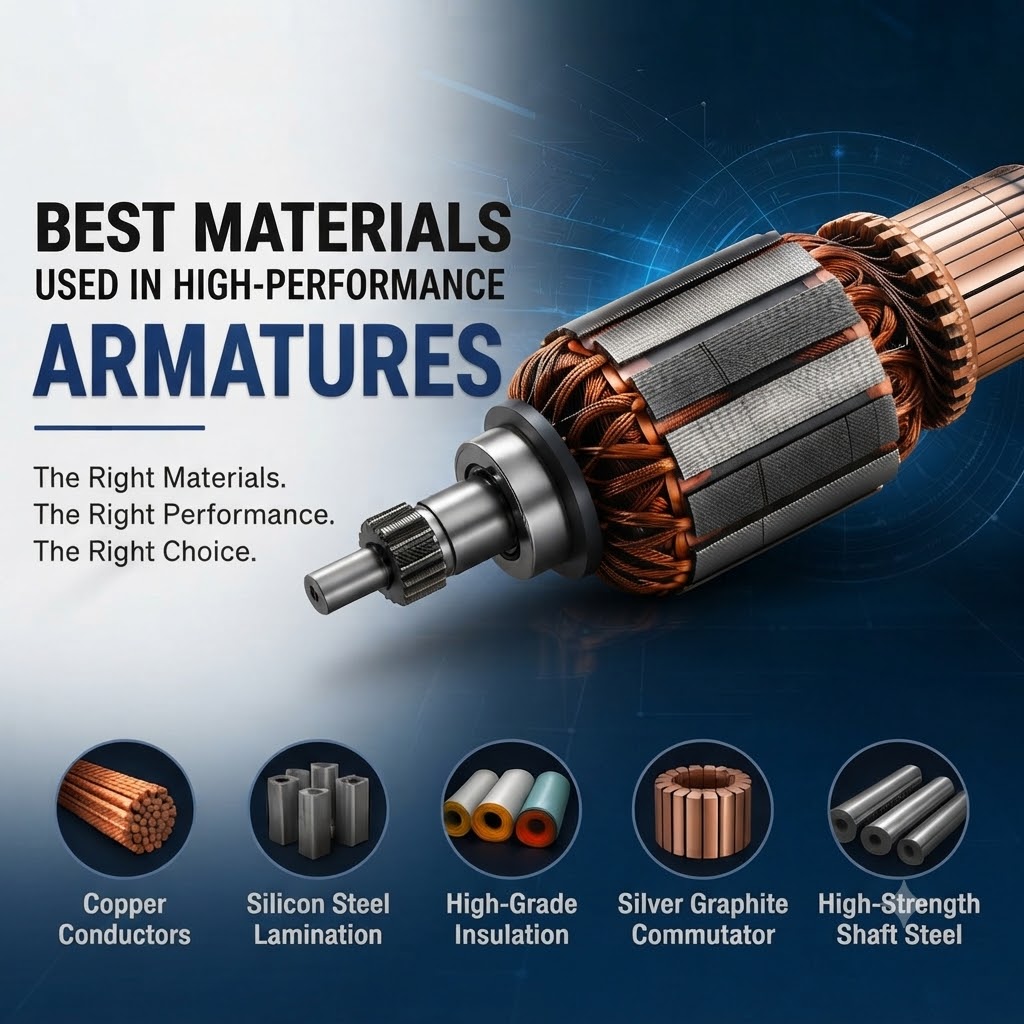
Best Materials Used in High-Performance Armatures
Introduction
The armature is one of the most critical components in electric motors and power tools. It converts electrical energy into mechanical motion, enabling equipment such as angle grinders, marble cutters, rotary hammers, drills, demolition hammers, circular saws, and other industrial machines to operate efficiently. The quality of an armature directly affects motor performance, power output, efficiency, durability, and service life.
As industries demand more reliable and high-performance power tools, manufacturers are increasingly focusing on using premium materials in armature construction. High-quality materials improve heat resistance, reduce electrical losses, enhance mechanical strength, and ensure consistent performance under heavy workloads.
Choosing the right materials for an armature is essential for achieving higher efficiency, reduced maintenance, and longer operational life. In this article, we explore the best materials used in manufacturing high-performance armatures and how each material contributes to superior motor performance.
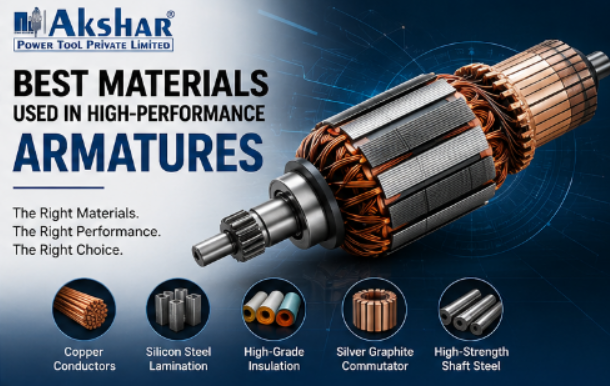
What Is an Armature?
An armature is the rotating part of an electric motor that carries the winding through which electrical current flows. As current passes through the windings and interacts with the magnetic field, rotational force is generated, driving the motor.
A typical armature consists of several key components:
- Armature core
- Copper windings
- Laminated steel stack
- Commutator
- Shaft
- Insulation materials
- Balancing elements
- Cooling structure
Each component must be manufactured using carefully selected materials to ensure reliable performance.
Importance of Material Selection
Material selection plays a major role in determining:
- Motor efficiency
- Heat dissipation
- Torque output
- Mechanical strength
- Electrical conductivity
- Wear resistance
- Corrosion resistance
- Service life
- Noise and vibration levels
- Overall reliability
Premium materials help motors perform efficiently even under continuous heavy-duty operation.
High-Grade Electrical Steel Laminations
The armature core is commonly manufactured using laminated electrical steel.
Instead of using a solid steel block, manufacturers stack thin laminations together to minimize eddy current losses.
Benefits
- Lower energy loss
- Improved magnetic efficiency
- Reduced heat generation
- Better motor performance
- Higher operating efficiency
High-grade silicon electrical steel is widely preferred because it offers excellent magnetic properties and lower core losses.
Silicon Steel
Silicon steel is among the most commonly used materials in premium armatures.
Adding silicon to steel improves magnetic characteristics while reducing electrical losses.
Advantages
- High magnetic permeability
- Low hysteresis loss
- Reduced eddy currents
- Better energy efficiency
- Improved thermal stability
Silicon steel is especially suitable for high-speed motors operating under demanding industrial conditions.
Electrolytic Copper Windings
Copper is the preferred conductor for high-performance armatures because of its excellent electrical conductivity.
Most premium armatures use high-purity electrolytic copper wire.
Benefits
- Excellent electrical conductivity
- Higher motor efficiency
- Lower resistance
- Reduced heat generation
- Better power transmission
- Longer service life
Compared to aluminum windings, copper provides higher efficiency and greater mechanical durability.
Oxygen-Free Copper
Many premium industrial motors utilize oxygen-free copper.
This material offers improved conductivity and reduced impurities.
Advantages include:
- Better current flow
- Higher efficiency
- Improved thermal performance
- Reduced oxidation
- Enhanced durability
Oxygen-free copper is commonly found in heavy-duty industrial power tools.
High-Temperature Enamel Insulation
Copper windings are coated with specialized enamel insulation.
Modern armatures often use high-temperature insulation materials capable of withstanding extreme operating conditions.
Common insulation classes include:
- Class B
- Class F
- Class H
High-quality insulation protects windings from:
- Short circuits
- Moisture
- Heat damage
- Abrasion
- Chemical exposure
Superior insulation significantly extends motor life.
Premium Commutator Copper
The commutator transfers electrical current to the rotating armature.
High-quality commutators are manufactured using precision-machined copper segments.
Benefits include:
- Smooth electrical contact
- Lower sparking
- Reduced wear
- Stable motor performance
- Longer brush life
Accurate machining improves electrical efficiency and minimizes maintenance requirements.
Mica Insulation
Copper commutator segments are separated using mica insulation.
Mica offers excellent electrical insulation while tolerating high temperatures.
Advantages include:
- Excellent dielectric strength
- Heat resistance
- Mechanical durability
- Long operational life
- Resistance to electrical arcing
Mica remains one of the most reliable insulating materials used in electric motors.
High-Strength Carbon Steel Shaft
The shaft supports the rotating armature assembly.
High-performance armatures typically use hardened carbon steel or alloy steel shafts.
Benefits include:
- High tensile strength
- Excellent fatigue resistance
- Precision alignment
- Reduced vibration
- Long bearing life
A strong shaft maintains accurate rotation under heavy mechanical loads.
Alloy Steel Components
Premium armatures often incorporate alloy steel parts for increased durability.
These materials provide:
- Higher strength
- Better wear resistance
- Improved toughness
- Corrosion resistance
- Enhanced dimensional stability
Alloy steels perform exceptionally well in industrial environments.
Epoxy Resin Impregnation
Modern armatures undergo vacuum pressure impregnation (VPI) using epoxy resin.
This process strengthens the winding assembly.
Benefits include:
- Improved insulation
- Moisture resistance
- Reduced vibration
- Better heat transfer
- Enhanced mechanical stability
Epoxy impregnation also protects against dust and chemicals.
Fiberglass Reinforcement
Fiberglass is widely used to reinforce armature windings.
Advantages include:
- High mechanical strength
- Excellent insulation
- Lightweight construction
- Heat resistance
- Vibration resistance
Fiberglass helps secure windings during high-speed rotation.
High-Performance Adhesives
Industrial armatures use specialized adhesives designed for high temperatures and vibration.
These adhesives help:
- Secure winding coils
- Prevent wire movement
- Reduce vibration
- Improve durability
- Maintain structural integrity
Proper bonding contributes to longer motor life.
Precision Ball Bearings
Although bearings are separate components, they directly influence armature performance.
High-quality bearings provide:
- Smooth rotation
- Reduced friction
- Lower noise
- Better efficiency
- Longer operating life
Premium bearings are manufactured using hardened bearing steel with precision tolerances.
Heat-Resistant Insulating Paper
Insulating paper separates winding layers and prevents electrical contact.
Modern insulating papers provide:
- Excellent dielectric properties
- Thermal resistance
- Moisture protection
- Mechanical strength
These materials improve the reliability of high-speed motors.
Polyester and Nomex Insulation
Advanced armatures frequently use polyester films and Nomex insulation materials.
Benefits include:
- High dielectric strength
- Excellent temperature resistance
- Chemical resistance
- Long service life
- Improved electrical safety
These materials are commonly used in industrial-grade power tools and motors.
Dynamic Balancing Materials
Every high-performance armature is dynamically balanced before assembly.
Manufacturers use balancing compounds or precision balancing weights to eliminate vibration.
Proper balancing provides:
- Smooth operation
- Reduced bearing wear
- Lower noise levels
- Increased cutting precision
- Longer motor lifespan
Dynamic balancing is especially important for high-speed tools.
Corrosion-Resistant Protective Coatings
Industrial environments often expose motors to moisture, dust, and chemicals.
Protective coatings help prevent:
- Rust formation
- Corrosion
- Surface oxidation
- Moisture penetration
These coatings improve long-term reliability, particularly in harsh operating conditions.
Advanced Cooling Materials
Heat is one of the biggest enemies of electric motors.
Modern armatures are designed using materials that improve cooling efficiency.
Examples include:
- Heat-resistant insulation
- Precision ventilation components
- High-conductivity copper
- Optimized lamination design
Effective heat management helps maintain consistent motor performance.
Why Material Quality Matters
Using premium materials provides several important advantages:
Higher Motor Efficiency
Better magnetic materials and superior copper windings reduce energy losses.
Longer Service Life
High-quality materials resist wear, fatigue, and thermal damage.
Improved Reliability
Premium armatures perform consistently under demanding workloads.
Reduced Maintenance
Superior materials reduce component failures and extend maintenance intervals.
Better Heat Management
Advanced insulation and conductive materials help control operating temperatures.
Enhanced Safety
Reliable insulation and precision manufacturing reduce the risk of electrical faults.
How to Identify a High-Quality Armature
When selecting an armature for industrial power tools, look for the following features:
- High-purity copper windings
- Silicon steel laminated core
- Precision-machined commutator
- High-temperature insulation
- Vacuum pressure impregnation (VPI)
- Dynamically balanced rotor
- Hardened steel shaft
- Premium-grade bearings
- Strong winding reinforcement
- Corrosion-resistant finishing
These characteristics indicate a durable, efficient, and high-performance armature suitable for demanding industrial applications.